Visiting exhibits – gold rings-insignis from the time of the bulgarian khanate
The monuments of the elite Old Bulgarian culture of the pagan period are identified in the representative palace architecture – administrative and private buildings, baths, temples, associated underground walkways and commemorative facilities. To these we refer to the graves of the Bulgarian aristocracy with the objects of luxury found in them: vessels of clay and metal, but also signs of prestige such as silver belts and gold ornaments. Their number is scarce, but it is an important testimony to the social differentiation in early medieval Bulgarian society in the 7th-9th centuries.
So far only 8 gold rings belonging to prominent representatives of the Bulgarian aristocracy of the period are known among the jewellery. What was their purpose indicates the ring, currently stored in the Treasury Hall of the Regional Museum of History – Shumen. It was discovered in the Outer Town of the capital city of Pliska, and on its rectangular plate is engraved an inscription in Greek: “These rings were given by the Archon (the ruler)“. According to the palaeography of the letters it dates back to the 9th century. The text indicates that the Roman-Byzantine practice of the emperor being the only one to give gold rings at the investiture of high dignitaries was in all likelihood also adopted in the Bulgarian khanate on the Lower Danube. Circumstantial evidence for this custom is the discovery of two gold medallions of Khan Omurtagh, probably given for merit to the ruler’s “fostered men“. Even more eloquent is the inscription of Khan Malamir (831 – 836) on the occasion of a water conduit built by the Khavhan Isbul” …the Archon gave the Bulgarians much to eat and drink, and to the “Buils” and the “Baghains” he gave great gifts“. In this sense the rings made of precious metal had the meaning of insignia.

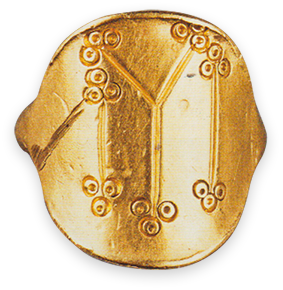
In addition to being given by the Archon, the rune-like signs inscribed on the tiles of some of them are indicative of their owners’ lineage. Such is the ring from the village of Brestovac (Croatia) with the sign “IYI” incised on it. Interpretations are multiple – a symbol of a ruling dynasty, a family sign or as a theonym of the Christian God. This ring, as part of a grave find from the second half of the 8th-9th centuries, was found together with gold belt fittings. Today it is stored in the Kunsthistorisches Museum in Vienna.

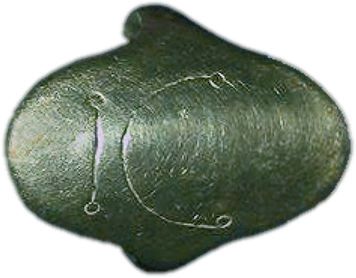
The third gold ring with a rare rune-like sign comes from the Kanagyol River, northeastern Bulgaria. The area falls along the route of the medieval road connecting the capitals of Pliska and Preslav with Druster (Silistra). It is currently of unknown location. It is also dated to the 9th century.

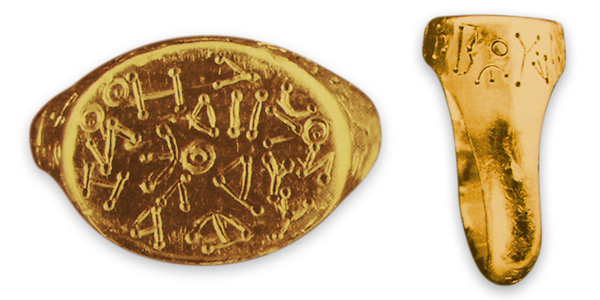
Also missing is a massive gold ring featuring an elliptical plate engraved with 20 rune-like signs. An additional 18 signs are applied along the sides of the plate and on the band, including a cross. Each “I” sign is accompanied by a recessed dimple. The ring is believed to originate from the Shumen region and most likely belonged to a person of very high social status in the 9th century.
In the exposition of the National Museum of History the remaining 4 gold rings are presented together for the first time. Two of them are of unknown origin, and the rest were recently discovered during archaeological excavations.

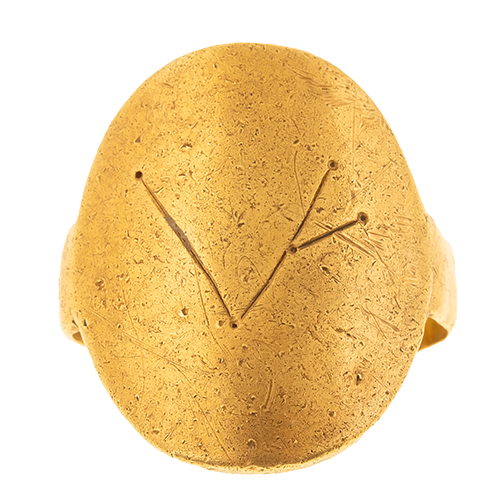
The massive ring from the village of Ivanovtsi, Vidin region, belongs to the type of rings with a large elliptical plate, positioned perpendicularly along its longitudinal axis relative to the open band. It was cast, and a rune-like sign with recessed dots at the ends of the strokes is engraved on the plate. It weighs 16.2 g and is dated to the 8th–9th century. The ring was acquired by the National Archaeological Institute with Museum (NAIM) in the 1930s.

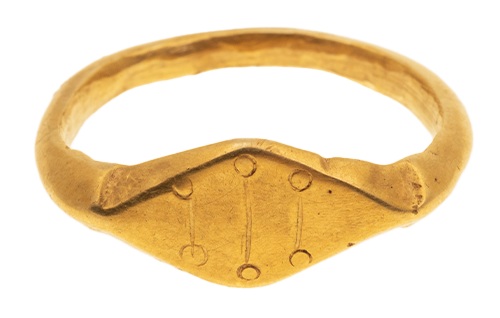
In 2023, during archaeological excavations of an Old Bulgarian settlement from the 8th – 9th centuries in the Kavlaklar locality, east of Pliska, a gracile gold ring weighing 3.77 g was discovered. . The small plate of the ring has an elongated rhomboid shape, which passes through a plastic transition to a faceted ring. On the plate is incised a rune-like mark of three parallel fine “I”, with a circle stamped at each end. The ring is made by casting and the decoration is chiselled. The unpretentious workmanship suggests local manufacture. It most probably belonged to a prominent member of the Bulgarian nobility of the 9th century.

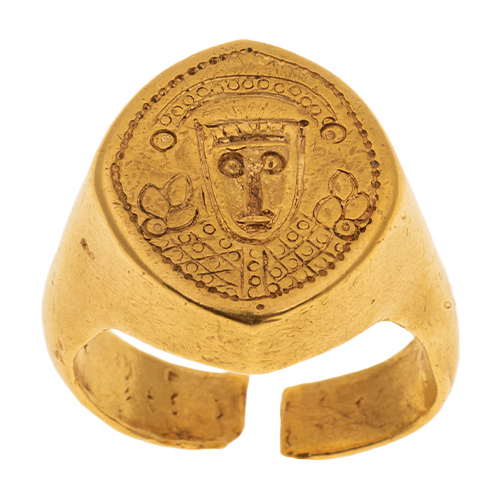
The signet ring from Pliska is most probably a product of a local studio. It impresses with its massiveness and weight of 26.93 g. It has a thick, almost circular, plate, which smoothly transitions into a massive ring. On the face there is a schematic anthropomorphic image in negative, crowned with a diadem with round appliqués. With more attention to detail, the garment/loros and an ornament with three leaves above the shoulders are depicted. Because of the attributes – diadem and loros, the image is interpreted as regal. Probably its owner stamped his acts and letters with it… The barely noticeable traces of deformation and especially the deliberately cut ring suggest many years of use. It was discovered in 2022 during archaeological excavations in the Inner City of Pliska. The context of the find is interesting, allowing for precise dating but also the possibility of more hypotheses about the owner of the ring. A gold follis of Emperor Theophilus (829 – 842), issue 830/831 – 840, was found in an adjacent pit of the same building, indicating production and use in the first half of the 9th century during the reigns of the khans: Krum (803 – 814), Omurtag (814 – 831), Malamir (831 – 836), or Presian (836 – 852).

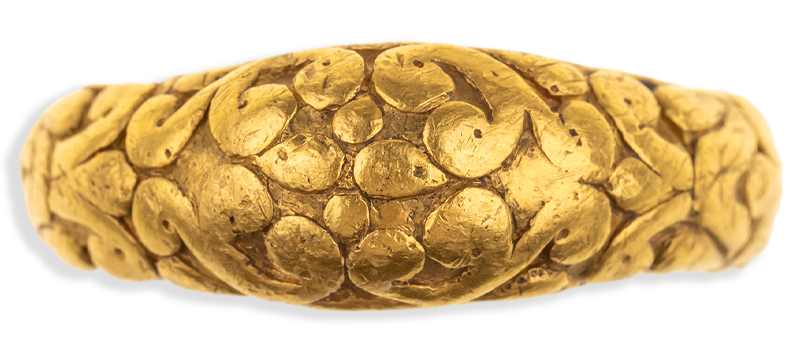
In the 1940s NAIM bought an impressive gold ring weighing 11.3 g. It was found near the village of. Mutnitsa, at the foot of the Madara cult centre. The ring is a massive ring, on the outside with a plastic decoration of banded lobes and volutes, symmetrically arranged around a four-leaf rosette. Only traces of black enamel preserved in the folds of the relief now suggest the original effect of the gold composition on a black enamel background. The quality of the workmanship in the Byzantine ‘rod-lastari’ style, current in the first half of the 8th century, argues for its manufacture in a Constantinople studio, subsequently ending up in the lands of the Bulgarian Khanate, perhaps as a diplomatic gift.

Reconstruction of the ring from the village of Mutnitsa.
The presented artifacts are exhibited thanks to the kind cooperation of the National Archaeological Institute with Museum and Regional Museum of History – Shumen.