On this day, 1928 years ago, Marcus Ulpius Trajan was proclaimed emperor of the Roman Empire. He ruled from 98 to 117 AD and is remembered as the second of the five good emperors of the Antonine dynasty.One of the most successful rulers, he led the legions during the greatest territorial expansion in Roman history, conquering Dacia, Nabataea, Armenia, Mesopotamia, and Assyria. The Roman Senate gave him the title Optimus (“the best”).
On this day, 1928 years ago, Marcus Ulpius Trajan was proclaimed emperor of the Roman Empire. He ruled from 98 to 117 AD and is remembered as the second of the Five Good Emperors of the Antonine dynasty. One of the most successful rulers, he led the legions during the greatest territorial expansion in Roman history, conquering Dacia, Nabataea, Armenia, Mesopotamia, and Assyria. The Roman Senate gave him the title Optimus (“the best”).
In today’s Eastern Balkans, there are many monuments preserved that are associated with his name. The cities of Nicopolis ad Nestum (near Gotse Delchev) and Nicopolis ad Istrum (near Veliko Tarnovo) were founded and named after his victory over the Dacians in 106 AD. In today’s town of Devnya, there is one of the towns renamed in honor of this victory – Marcianopolis. During his reign, Serdica (today’s Sofia), Pautalia (today’s Kyustendil), Augusta Traiana (today’s Stara Zagora), Ratiaria (now the village of Gigen) bore one of his family names, Ulpia. His construction achievements were enormous, not only in the Balkans but throughout the empire.
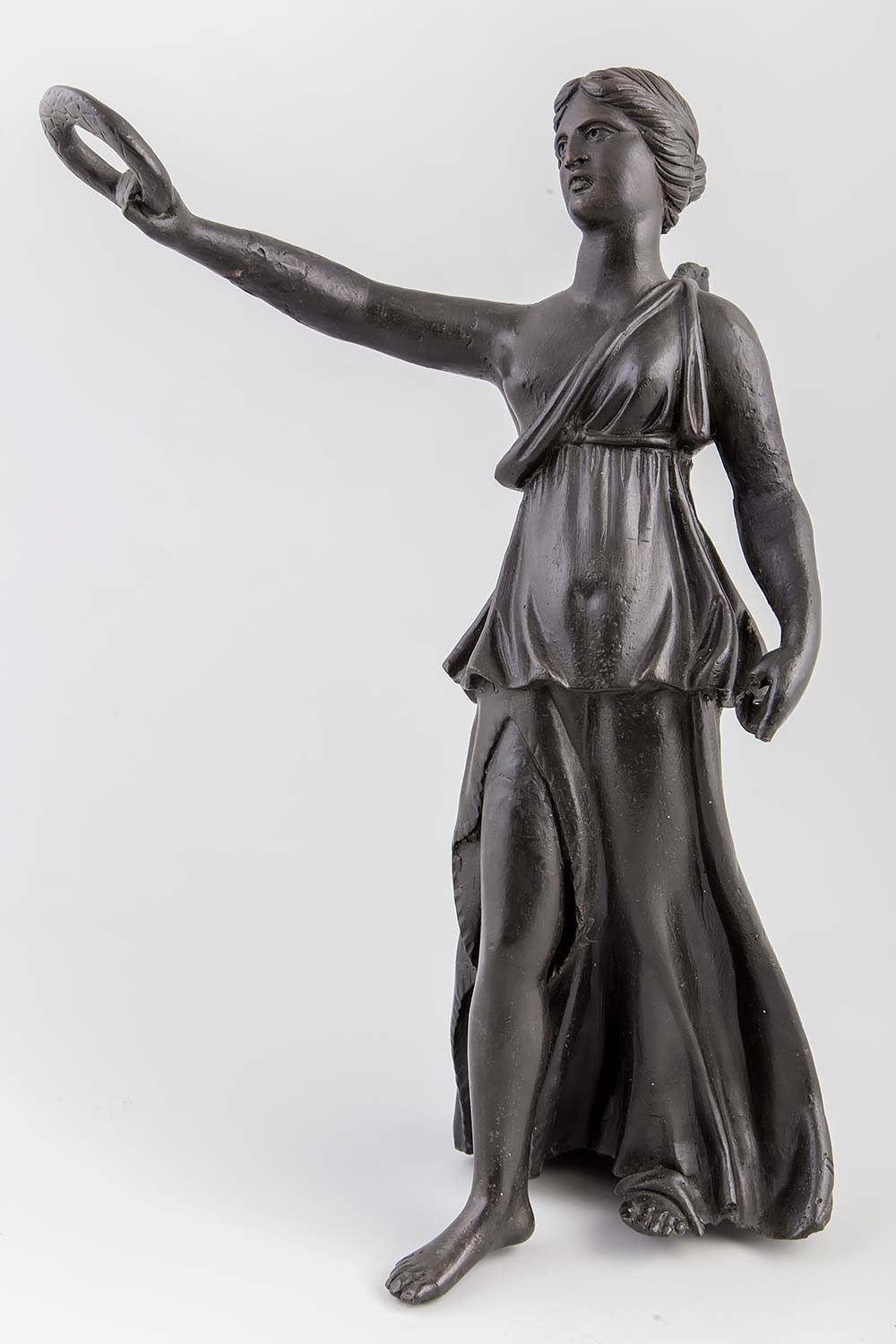
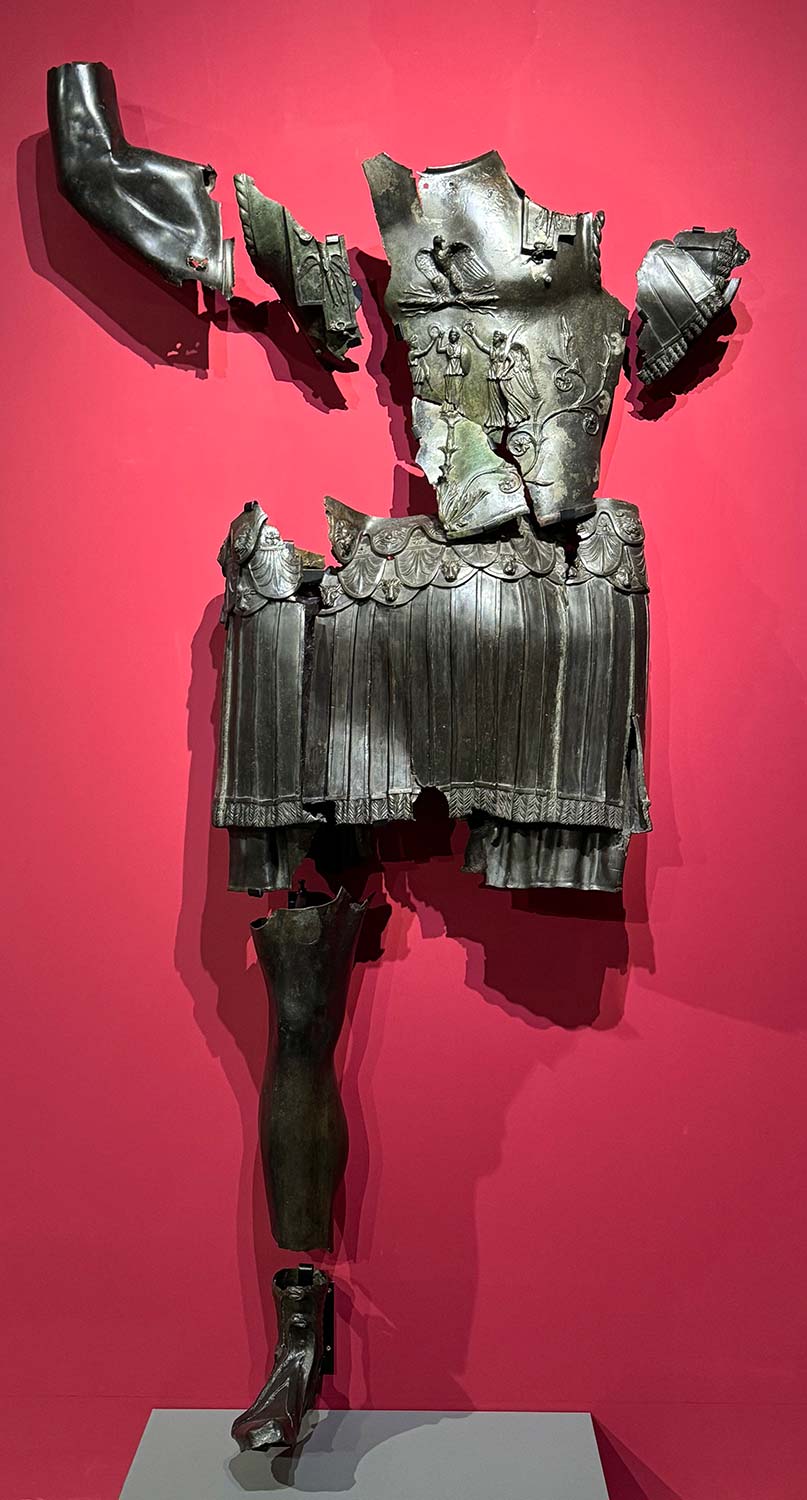
In Hall 2 of the Bulgarian Historical Museum, there is a bronze statue dedicated to Emperor Trajan. The statue was found in 1984 on the banks of the Danube River by geologists, who believed that the pieces had been arranged rather than thrown away. The place where it was found is associated with the Roman military camp Nigrinianus, located near Durostorum (now Silistra) and known from ancient itineraries (travel guides). A statue of Victoria was also found alongside the fragments. The statue was over three meters tall, which clearly identifies it as an imperial image.
Three figures are depicted in the central part of the shield. In the middle stands Minerva, the patron goddess of Rome, and on either side of her is a Victoria (the goddess of victory) holding a wreath in her hand to crown Minerva.
Above this scene is the most important motif from the decoration of the armor—an eagle clutching a lightning bolt; this is one of the most commonly used symbols on the flags of the legions. This symbol is also found on bricks bearing the name of the XI Claudian Legion, in whose area the statue was found, as well as on the V Macedonian Legion, located further east.
Text: Mikhail Vaklinov