Levski Day
“I work for the Fatherland, sir! Tell me my faults and I will tell you yours, so that we can correct them and all move forward together.”
V. Levski
On this day 153 years ago, the Bulgarian people lost their loyal son Vasil Levski. Captured and convicted by a Turkish court, Vasil Ivanov Kunchev (Levski) was hanged on February 18 (6 according to the old calendar) 1873 on the outskirts of Sofia.
Driven by love for his homeland and a desire for freedom, Levski followed in the footsteps of Bulgarian revolutionaries from an early age. The life and revolutionary experience he gained in the 1860s from his participation in the First and Second Bulgarian Legions, Panayot Hitov’s band, and his familiarity with the hardships of the Bulgarian rebels and the suffering of the Bulgarian people in the enslaved lands shaped Levski’s ideas for winning freedom.
Levski sincerely believed in the strength and ability of the Bulgarian people to win their freedom with weapons in hand. He passed this belief on to his oppressed brothers. It drove him in his tireless work to build the Internal Revolutionary Organization (IRO) in the Bulgarian lands, in his activities in the Bulgarian Revolutionary Central Committee (BRCC), and in his final moments before the gallows. The spark ignited by the Apostle and his revolutionary brothers burst into a raging fire in the spring of 1876. The self-sacrifice and heroism of the Bulgarian people in the April Uprising (1876) and the subsequent Russo-Turkish War (1877-1878) led to the restoration of the Bulgarian state on the map of Europe.
In life and in death, Levski put the freedom of his homeland first. That is why, during his lifetime, the people called him the Apostle of Freedom. It is no coincidence that organized celebrations in his memory began shortly after the Liberation. Initially, the date of his death began to be marked with memorial services and modest ceremonies, mainly by his comrades and relatives. The monument to Vasil Levski in Sofia, unveiled on October 22, 1895, became the center of the annual commemorative ceremonies on February 18 and 19. In 1898, on the occasion of the 25th anniversary of the Apostle’s death, the first events in memory of the hero were organized throughout the country.
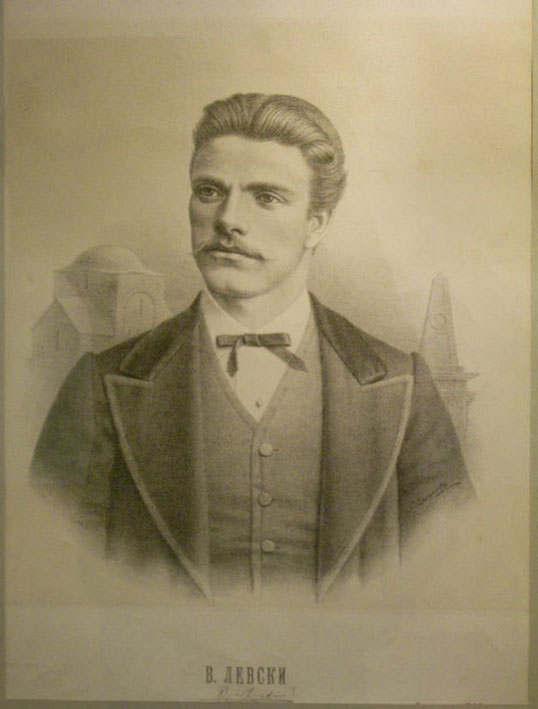
The Bulgarian people still express their respect and admiration for Levski’s personality, work, and sacrifice today. Hall 4 of the permanent exhibition at the National Historical Museum displays a number of exhibits related to the life and work of the Apostle, which museum visitors can view. Among them, of particular interest is a lithograph made in 1897 by his comrade-in-arms and freedom fighter Georgi Danchov-Zograf from Chirpan. The exceptional value of this museum exhibit stems from the fact that it is an original and, secondly, that according to the Apostle’s comrades and close friends, this lithograph most closely resembles the image and character of the national hero. Last but not least, its value is also determined by the author himself. It is a well-known fact that Georgi Danchov-Zograf painted other portraits of the Apostle, authored “An Epic of the Forgotten in Pictures,” and painted and lithographed portraits of Z. Stoyanov, St. Stambolov, G. S. Rakovski, L. Karavelov, Hr. Botev, “Free Bulgaria,” and others.
Text: Petrana Kamenova